
Building on its flexibility
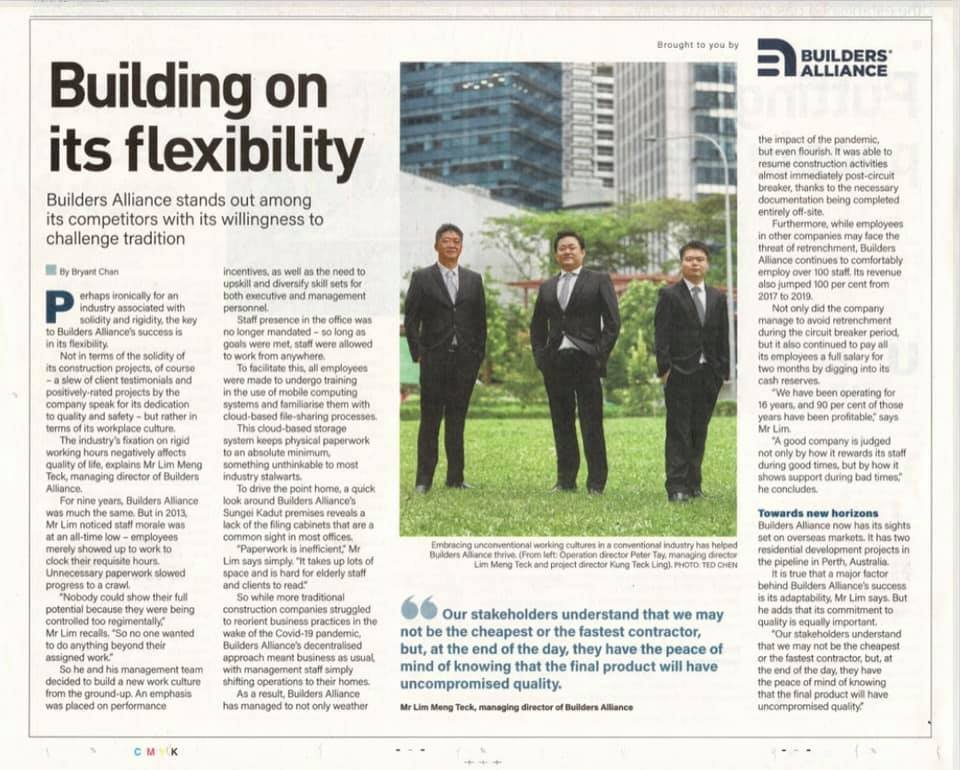
Builders Alliance stands out among its competitors with its willingness to challenge tradition

Perhaps ironically for an industry associated with solidity and rigidity, the key to Builders Alliance’s success is in its flexibility.
Not in terms of the solidity of its construction projects, of course — a slew of client testimonials and positively-rated projects by the company speak for its dedication to quality and safety — but rather in terms of its workplace culture.
The industry’s fixation on rigid working hours negatively affects quality of life, explains Mr. Lim Meng Teck, Managing Director of Builders Alliance.
For nine years, Builders Alliance was much the same. But in 2013, Mr. Lim noticed staff morale was at an all-time low — employees merely showed up to work to clock their requisite hours. Unnecessary paperwork slowed progress to a crawl.
“Nobody could show their full potential because they were being controlled too regimentally. So no one wanted to do anything beyond their assigned work.”
So he and his management team decided to build a new work culture from the ground up. An emphasis was placed on performance incentives, as well as the need to upskill and diversify skill sets for both executive and management personnel.
Staff presence in the office was no longer mandated — so long as goals were met, staff were allowed to work from anywhere.
To facilitate this, all employees were made to undergo training in the use of mobile computing systems and familiarise them with cloud-based file sharing processes.
This cloud-based storage system keeps physical paperwork to an absolute minimum, something unthinkable to most industry stalwarts.
To drive the point home, a quick look around Builders Alliance’s Sungei Kadut premises reveals a lack of the filing cabinets that are a common sight in most offices.
“Paperwork is inefficient. It takes up lots of space and is hard for elderly staff and clients to read.”
So, while more traditional construction companies struggled to reorient their business practices in the wake of the COVID-19 pandemic, Builders Alliance’s decentralised approach meant business as usual, with management staff simply shifting operations to their homes.
As a result, Builders Alliance has managed to not only weather the impact of the pandemic, but even flourish. They were able to resume construction activities almost immediately after the circuit breaker, thanks to completing all necessary documentation entirely off-site.
Furthermore, while employees in other companies may face the threat of retrenchment, Builders Alliance continues to comfortably employ over 100 staff. Its revenue also jumped 100% from 2017 to 2019.
Not only did the company manage to avoid retrenchment during the circuit breaker period, but it also continued to pay all its employees a full salary for 2 months by digging into its cash reserves.
“We have been operating for 16 years, and 90% of those years have been profitable,” says Mr. Lim.
“A good company is judged not only by how it rewards its staff during good times, but by how it shows support during bad times,” he concludes.
“Our stakeholders understand that we may not be the cheapest or the fastest contractor, but at the end of the day, they have the peace of mind of knowing that the final product will have uncompromised quality.”
Mr. Lim Meng Teck, Managing Director of Builders AllianceTowards new horizons
Builders Alliance now has its sights set on the overseas market. It has two residential development projects in the pipeline in Perth, Australia.
It is true that a major factor behind Builders Alliance’s success is its adaptability, Mr. Lim says. But he adds that its commitment to quality is equally important.